Showing posts with label OBS Banner. Show all posts

Monday, July 16, 2018

Mechanika: RPG Review


MECHANIKA
This is a review portable document format (PDF) of Mechanika: Empires of Blood and Steam; by Xaos Publishing. This product was provided free of charge for the purpose of this review. Mechanika funded for just over $9k, via Kickstarter in 2013, with the final push for delivery, fulfillment, and eventually availability at drivethrurpg.com and RPGNow.com, occurring mid, 2016.

Disclosure: This review includes affiliate links to DriveThruRPG.com. I receive a small percentage if you decide to purchase something from the landing page. Thank you for your support.

Mechanika is a bit of an odd duck as far as RPGs go. While I wouldn’t disagree that its theme is steampunk, the more I read and as the pages went by, less did this game feel like a steampunk RPG. When I brought out the dice, for character creation, and to test some of the mechanics all heck broke loose!
As the author admits, Mechanika is a bit of a mash or perhaps a rehash of many other RPGs. There is certainly a bit of Fate Core here and a bit a Savage Worlds there. Add in a hint of gothic fantasy, a little (non-plushy) Call of Cthulhu and that about sums it up. I’m a bit on the fence with this one, but it is less about what this game is and more about what it could be, which admittedly doesn’t give credence to the idea of paying money for it. Steampunk isn’t an RPG genre I’m too familiar with, but setting wise this RPG is absolutely a mash of many elements other than steampunk. Gamers familiar with Fate Core or Savage Worlds might consider giving it whirl, but at the same time Mechanika, is very different from those RPGs.

Mechanika utilizes the Xaos system. Dice mechanics are performed with percentile dice (d10s) and FUDGE dice. If you not familiar with FATE CORE, FUDGE dice are six-sided die, which are faced with icons instead of numbers. The icons for Fate Core & Mechanika are plus (+), minus (-) or blank (_); two of each icon on a d6. Needless to say, but easy enough to simulate on a standard d6 as well, assigning two numbers to each icon.
Beside the basic rolls which entail those improved by character skills/attributes/perks, or challenged by flaws, the Xaos System allows for degrees of success and failure. In other words, meeting the target number set by the GM is a success, but exceeding the number may count towards a special success. As such, rolling well below the target number may count as a “special” failure. Either occurrence encourages the GM and the players to incorporate some narrative story elements. The Xaos system also features a luck mechanic for dice rolls called Destiny Points. Those familiar with Savage Worlds and Fate Core will recognize it, as this mechanic allows rerolls as well as enables players to “edit a scene,” avoid an untimely death and a couple of other things. Destiny Points are rewarded to the player by the GM, mostly in regards to good character play. These points roll over to experience points for the character if unused at the conclusion of the session. Speaking of character, let’s make one.

Character creation with this RPG requires players to create a persona. The concept of this persona is then mitigated by two character concepts the “higher” and “lower” self. In essence instead of alignment we have a default character personality tag. The higher self is just as it seems, your character at his/her best, or most selfless, the lower self being your character’s worst or most selfish. Players are charged with creating these three tags and putting them together in a way that is somewhat reasonable. There are plenty of examples (for newbs) to get you started, and the concepts in this section are well presented.
Best Selling RPGs - Available Now @ DriveThruRPG.com

Next is selecting a race of which there is a unique variety. Humans make up 80% of the current population of this alternate earth/steam punk setting, but my beloved dwarf is available (so I made one), as well as goblins, moreauvians, sylvans and Dhampyrs. Moreauvians are human/animal hybrids and of many varieties, sylvan are plant or tree like humanoids and dhampyrs are the spawn of vampires. Races have a high number racially specific, drawbacks and benefits. The race template is a bit overloaded in this regard. Thankful I located a pencil that Harley the cat, hadn’t yet had the pleasure of chewing on (don’t ask).

Step three is assigning attributes and wounds. Attributes in Mechanika are the physical and mental aptitude however, a score of zero is considered the human average. With creation, player characters are provided five points to distribute among these attributes, as well as some attributes may be further modified by the race template. Mechanika does not use a typical Hit Point system, instead incorporating a (meticulously written) wound system, which includes three different types of wounds, to show damage.
"Every character in Mechanika has their limits. Every character has a breaking point. This is illustrated by the Wounds system. The Wounds system gives you a visual representation of how injured you are by using damage grids. Each character has three different grids, one for each type of wound you can sustain in Mechanika.” (PG 46)
Character’s in Mechanika can take physical damage (Constitution), stress or mental damage (Willpower) and ego or social damage (Presence). The severity of injury for each type of damage is further divided into three additional ranks, each being more severe. The different sorts of damage will play more into the story building aspects, but also have mechanical significance providing penalties and the like.

Next in character creation, is the odd combination of assigning wealth and designating the number of actions available. There is really nothing to choose here, so it is really more of a “to make you aware section.” All characters are suggested at starting out with a -1 wealth rating or in other words, not very wealthy. Characters start the game with three sorts of actions, but may receive more if they have the appropriate ranks in agility attribute.


Rounding it out is selecting skills, perks, and flaws. These sections are pretty standard as far as RPGs go. Skills are linked to one or two designated attributes and help define what characters can and presumably, cannot do; all of these are based on character knowledge/education. Perks are divided into three categories: regular, supernatural and by race (race: listed with the race template). Likely my preference for old school games, but some of these read in line with what I would say was a skill, others are seemingly genetic graces and more in line with what I think a perk might be. Flaws can be taken at character creation, and award Experience Points (EPs), which you can put towards additional perks and skills during character creation.
Review Featured in KoDT #245
The setting of Mechanika is earth with an alternate timeline and a mash of several themes. At some point in this timeline the Old Ones (H.P. Lovecraft style) arrive plunging the earth in fifty years of despair. The effect of their presence causes disease, mutation and misery. The Fae arrive; from where the text isn’t clear. They fight the Old Ones offering humanity servitude, claiming themselves the saviors of the human race. The war between the Fae and Old Ones continues and somewhere in there the dwarves and goblins arrive. The dwarfs work both sides for profit, the goblins are mostly combat fodder. The Great War spans 250 years, until the Fae gain dominance. For one thousand years the Fae are worshiped unchallenged, when without explanation they disappear. There is a bit of unrest between the three lesser races as they via for power. And this is the setting Mechanika is subtitled and player character will explore: The Age of Blood and Steam.

Likely the best material to get a feel for Mechanika, are the chapters to do with machina and magic. Interestingly, there is about twice as much content on the chapter for magic then there is for the chapter on machina. That said… the chapter on machina is pretty interesting. Both magic and machina rely on Flux, which is the source of magic energy. For the most part this section provides a handy set of guidelines for Artificers and Tinkerers to construct their own gizmos, which are machines/devices melded with this element of flux. Artifice Houses specialize in creating certain types of machina and each house is provided a treatment specifically describing what can be created as well as provides a few examples. Despite seeming a bit overflowing for a steampunk RPG, the Chapter on Magic is my actually my favorite. Magi in Mechanika belong to one of twelve houses, Warlocks wield elemental forces and Wyrds unstudied, but naturally gifted, harness their innate magical talents through a totem. The features of the three magic-user archetypes are diverse and interesting. The magic schools are subdivided by type: The Schools Elements, Matter, Energy, Life & Death and the Aberrant Schools.

While Mechanika is bit wonky, if I had put my money down, there are certainly some interesting concepts. The writing isn’t terrible, but the overall layout and presentation could certainly use some additional work. This being a Steampunk game, as I mentioned in the intro, it’s rather odd. While the games “theme” is steampunk it’s got a bulky dose of other things, which significantly weigh it down in regards to mechanics as well as to the core of its role-playing elements. If Mechanika was developed in the early 90’s no doubt it would have likely gained a fan base. As is, I’d wait to see if some of these things might be cleaned up and if it should ever come to pass with a second edition.

Monday, June 18, 2018

Strange Stars: RPG Review

Strange Stars
This is a review of the portable document format (PDF) of the Strange Stars Game Setting Book, Published By: Hydra Cooperative; written By: Trey Causey...

Disclosure: This review includes affiliate links to drivethrurpg; I receive a % if you decide to purchase something from the landing page.

Strange Stars is available at drivethrurpg.com and rpgnow.com in print and PDF format. On hand, I was also provided the Strange Stars OSR Rule Book and the Strange Stars Fate (Core) Rule Book, which this review mentions in brief. These products were provided by Hydra Cooperative free of charge, for the purpose of this review.

The Strange Stars Setting book is compact: 32 pages cover to cover. Unfortunately, it’s so compact that the effort to put forth what I’d consider a “setting book,” has been nearly squeezed to irrelevance. That’s certainly my opinion. While I get what this product is, after I finished my read, my conclusion was that it’s not properly defined. If the book was subtitled: Game Setting “Treatment,” this review would be a little less harsh. Being fair, I certainly seem to be in the minority with this opinion. I’d recalled seeing a high number of positive reviews (and 5 star rates) for this product, but after my impression I was compelled to take a second look at those reviews.
“If you are looking for a book filled with rich histories, detailed customs and lifestyles of each planet and race- then this might not be the book for you.”
Or in other words, nearly the exact definition of what a setting book might be?

This one, is my favorite:
“The layout is smooth, easy to read, & gives not only a gist of the interstellar setting but an entire setting straight out of the box.”

Review featured in KoDT #244
This reviewer is overstating it a bit: An entire setting straight out of the box? This statement is false. A concept of a setting is not for all intents and purposes, a setting. The closest thing I can think of, as to what this product represents in layout and art direction, is a splatbook. In fact, as I write this, I look up the term splatbook (as my mind grasps at what to call it) and here is the first result that sums it up nicely:
“A Splatbook is a non-core sourcebook for an RPG that provides additional rules and material that can be used with the main system.”
 And yes, this is what the Strange Stars, Game Setting Book is, a system less, space opera splat-book.

As far as system, mentioned in the book is a loose association for the RPG: Stars Without Number (SWN), which you can find and download for free on DriveThrurpg.com. If I’m remembering correctly, the tech level for Strange Stars seems a bit advanced for SWN. The two additional titles for this review: Strange Stars OSR Rule Book (which works with SWR) and the Strange Stars Fate (Core) Rule Book roughly follow the same splatbook format, but do provide some serviceable crunch to their respective systems. Let’s talk about the actual book.

First is an overview of the setting. A brief history notes, the four epochs of human space exploration. Earth, known as Old Earth is a fable. Other empires have left behind remnants of advanced technology.

Creatures in the setting are categorized as Sophonts: biological creatures, Moravecs: self-replicating, sapient robots, and Infosophonts: digital minds independent of physical form. Ten or so variants are given a fully illustrated one page treatment and a few details in text. As this book is system less no crunch. These illustrative treatments don’t have their own chapter, but are spread every other page.

Old School RPGs - Available Now @ DriveThruRPG.com

Between those pages and starting after the history is the meat of the setting. System maps give a brief treatment to each of the worlds of these systems, slightly detailing inhabitants and basic social conflicts/customs. This is exactly the thing that was missing and was my chief criticism for the Redemption RPG (link to that RPG Review). The system maps and the ideas on how to use them (for RPG purposes), provides the GM a handy resource to work from. On the other hand, Redemption had about 100 pages of detailed setting and history, which Strange Stars doesn’t even compare. The book ends with a number of thoughtfully presented one page treatments, which should aid the GM in getting adventures in this system going.

Certain, Strange Stars wasn’t my cup of coffee. There is a difference between a setting book and splatbook. The art is beautiful to a point, but mundane in it’s over use. I like my setting books with content. The layout is simple to navigate, because the concepts don’t run very deep, and moreover, neither provide the appropriate amount of detail in what should be included with a setting book. If you’re in the market for a space opera setting book, I’d certainly encourage you to look elsewhere.

Tuesday, May 15, 2018

Wandering Heroes of Ogre Gate: RPG Review

Wandering Heroes Of Ogre Gate
Welcome to a review of the portable document format (PDF) of Wandering Heroes of Ogre Gate. A wuxia & xianxia inspired role-playing game (RPG). Don’t know what wuxia or xianxia is? Admittedly, I had only a passing knowledge myself. We’ll get to that. Digitizing in before me is nearly 500 pages of game content.

Disclosure: This review includes affiliate links. I receive a token % if you purchase something from the landing page. Any purchase you make supports this blog; thank you for the support.

Wandering Heroes of Ogre Gate is available in Hardcover, softcover and PDF at studio2publishing.com and at OBS sites (RPGNow & DriveThruRPG) Bedrock Games is an active indie publisher and has a number of RPG products available. This is the second RPG product (Mafia Cosa Nostra being the first) I’ve had the pleasure to review for this column.

A brief on Wuxia and Xianxia:

One of the most well-known and readily available examples of wuxia is the movie Hidden Tiger, Crouching Dragon. If you haven’t seen this movie I highly recommend you do. If you don’t care to learn what wuxia is, I still recommend it. It’s good. To put it roughly, wuxia is Chinese mythologies knight errand. The literal definition is martial hero. Typically, these heroes roam the land righting wrongs, for the sake of virtue, instead of a typical knighted hero, for god and country. The driving elements in wuxia or of a wuxia story, are the martial artists’ journey for virtue itself-to do a thing because it is virtuous, rather than as with the western ideal, in the name of said virtue.

Xianxia literally means immortal hero. A xianxia story deals in the fantastical, bringing in the elements of demons and magic wrapped in Chinese mythology. The merge of these elements is attributed to the influence of Taoism, a real world religion being practiced today. While martial arts are a prime feature in wuxia, in xianxia martial arts are an element of the story. Xianxia themes are more to do with the supernatural. The best western movie I can think of to compare (or one which you may have seen) is Big Trouble in Little China; this to me, is a xianxia movie. Thankfully, the preface provides an explanation that should have any westerner ignorance covered, or least does so in an effort to create a roleplaying game with these themes. Now that we’ve covered that in brief, let’s get to it!

The setting of Wandering Heroes of Ogre Gate is Qi Xien, the realm of man, which following the multiple definitions used by Chinese language also implies the physical world players will explore. To say that amount of setting detail in Wandering Heroes of Ogre Gate impressed, is putting it mildly.

Historical Eras are succinctly defined providing a mythological themed “beginning of time” and a brief description for each of the following eras to the setting’s present. The timeline encompasses about 4,000 years of Qi Xien (fictional) history. A few of these eras even come with their-own map! Those that read this column know that if this reviewer is a sucker for anything; its maps and setting. Wandering Heroes of Ogre Gate has both. Admittedly, the setting elements of this RPG were the first chapters/sections I jumped to when I began my review. Beyond eras, lengthy sections expand and tie in the basics of Qi Xien: religions, cosmology, customs & daily life.

Chapter Eight: People & Places-provides a detailed outline of the Zhan Dao Empire, (the likely, governmental protagonist) and a number of brief outlines for the independent regions and cities beyond. Just about every notable region, or city location indicated on the map, is provided a treatment. While a picture paints a thousand words, the description provided in regards to the setting make sure that this picture is specific (or at least will be) in the theater of the (players/GMs) mind. Wander Heroes of Ogre Gate doesn’t imply, it richly describes it.

A bit of an aside, but with a little improvisation the setting elements of this RPG could certainly be inserted into just about any medieval fantasy setting. I have some thoughts to even incorporate Wandering Heroes of Ogre Gate as a land afar, for my current D&D basic campaign. Let’s move on to the fiddly bits, otherwise known as game mechanics.           

Review featured in KoDT #243
Wandering Heroes of Ogre Gate utilizes a variation of the Network System. Mechanically, the Network System is a skill based system. Characters don’t have what we classically consider attribute or ability scores, which aim to simulate physical and mental aptitudes. The system utilizes a D10 dice pool. Unlike previous editions the system, Wandering Heroes of Ogre Gate incorporates incremental numerical (+1 or -2 etc.) modifiers. Difficulty is determined by the Game Master and can be adjusted by situational modifiers and/or, martial hero capability.

A character’s skill or level of aptitude directly correlates to the total number of dice rolled for a check. With the target number set by the GM, as long as one of the dice rolled is a number equal or greater than TN, the character succeeds. A specific action which is determined by roll of the dice is a success, a greater than normal success, or failure.

A few particulars of this system are that with an unskilled check or trying to something in which a character has no rank in the relevant skill; the roll is 2d10 and the lowest result is taken. Penalty and condition modifiers can alter a roll dramatically reducing or increasing the dice roll by as much as (+/-) 3d10. In addition these modifiers, additional numerical modifiers equal to the number of dice, which are added (favorable) or subtracted (unfavorable) from the result. Rolling an unmodified 10 is counted as a greater than normal success and awards a bonus dependent on the specific nature of the roll, be it in the attempt at a skill or combat roll.

I’ve done a couple a reviews without; so let’s make a character!

Character creation in Wandering Heroes of Ogre Gate is no simple task. The reason for this is the number of options and the meticulous nature of the writing. Right away, while everything is clearly outlined and this being my first delve into making my martial hero, I can tell I’m in for it. I’m giving a brief treatment here rather than covering all of the thirteen steps.

Step One is picking a race. There are four other worldly options besides being human and the subtle features of these races (advantages/disadvantages) are borrowed from Chinese mythology. I took the road most traveled here and selected a human.

Step Two Primary Skill Groups. Players select their primary and secondary skills groups, note, not the actual skills themselves, until (step seven) the character is better fleshed out. Primary skills are selected among two of the six total categories, and receive 12 points for each. Six points are given for Secondary skills and can be among any of the other six categories. What interesting about this section is the ability for characters to increase the physic of their characters is possible by availability of skill ranks which reflect physical aptitudes. Most skill based systems avoid the mechanics of physicality (or at least the ones I’ve read mostly do), but as the practice of martial arts is certainly a physical activity I was glad to see these options. Skills are divided into two categories General and Expertise.

Step Three is to Select a Sect and/or Sifu. I’ll let the game speak for itself here:
 “Martial sects are organized groups of Kung Fu Experts and come in many forms. Some sects are associations or communities, some are religious orders and others are martial arts schools. Sects are divided into orthodox and unorthodox sects….” (PG 190; Martial Sects, CHPT 6)
There are a dozen sects to choose from. Each are provided a brief treatment: History, Organization Belief, Reputation & available martial arts techniques. If I ran a Campaign, I would certainly have the players start in the same sect, though this isn’t a requirement.

Savage Worlds: Fast, Furious, and Fun! - Available Now @ DriveThruRPG.com

Step Six, is selecting from among four Kung-Fu disciplines which players previously allocated points to determine proficiency. Each discipline has a specific number of techniques attributed. What’s most interesting here is the way Wandering Heroes of Ogre Gate balances a characters ability to utilize techniques by creating an applicable mechanic: imbalance and limiting the initial techniques that are available via sect/Sifu. Each of the four disciplines, the available techniques and options receives a detailed treatment encompassing roughly 60 pages of content.

Wandering Heroes of Ogre Gate is certainly not an entry level RPG. Though a minor point, that could be a criticism, but if it is, it’s really the only one I can muster up. The level of detail is likely the first thing you’ll notice if you pick it up. In fact, as I wrote this review I had to carefully decide what to include and there is a lot of good and great content here I’m not mentioning.

The layout and organization is very important in a product like this due to its sheer enormity, but thankfully the table of contents acts as a mini index; chapters and heading titles have been thoughtfully linked in the PDF. One click and you arrive. Beyond what is written I can honestly say that there wasn’t a single aesthetic that I didn’t like; which is pretty rare. I usually find something to nit-pick. The clean lines and effects of the interior black and white illustrations, certainly add to the wuxia and xianxia vibe. The artist Jackie Musto is awesome! As is the cartography work. The maps, borders, headers and side pane illustrations are very trim this product nicely.

Wandering Heroes of Ogre Gate is a product I defiantly recommend. And in so far, the best RPG I’ve reviewed, this year.

Friday, September 1, 2017

RPG Review: Werewolf the Forsaken 2nd Edition

WtF 2E
This is a review the portable document format (PDF) of Werewolf the Forsaken 2nd Edition, published By: Onyx Path Publishing (company site)which is available in PDF as well as in full color, hard cover print. Either product can be purchased at DriveThruRPG.com and RPGNow.com. To assist with saving space, Werewolf the Forsaken 2nd Edition will occasionally be shortened to WtF 2Ed.
Disclosure: The links (& product images) within this post include my drivethrurpg.com affiliate identification. I receive a token % if you purchase something from the landing page. It's one way to show support of this blog and its content; share, like, subscribe, is another. Thank you.

Onyx Path Publishing (OPP) is the licensed publisher of White Wolf (WW) products and has been since 2012. I queried the company on a complete lark, inspired by the quality of the art: which for this book is absolutely beautiful. It wasn’t till I clicked off the first page that I realized that this product (OPP) was once that (WW) product.

Honestly, I had some trouble with this review. This is the (second, no) third draft. I usually don’t draft. When I finished reading Wtf 2Ed, I wasn’t evaluating it fairly. What happened?

Well, my first problem was that I have a habit of perceiving RPGs in a bubble. Sometimes this approach is works, other times (like for this game) it doesn’t. The second problem (upon thoughtful reflection) is that RPGs are not meant for just reading or case in point, reviewing. RPGs are meant for gaming. Read, comprehended and played. Certainly, the middle one took more time, than most games require.

The main issue with Werewolf the Forsaken 2nd Edition is that the beginning text assumes familiarity. This fact put me a bit off my normal review talents because obviously I was unfamiliar, and neither did this situation provide a simple read. Not even my vague 90’s recollections of the White Wolf games I played back in the day could assist me. To make long story short (too late) comprehension required more than one pass.

My criticism of this RPG is it’s a bit over sophisticated. The confusion starts at the table of contents with how the chapters are titled and continues through with the introduction of vocabulary which is presumed the reader already understands the significance of. It’s not that the game doesn’t define itself, it actually does it very well-it’s about how it goes about defining itself.

While the writing itself is excellent and the art is spectacular, the organization and layout is far from intuitive. I saw this as a problem concerning new storytellers (or GMs) and players. Then again maybe I’m being unfair, as WtF 2Ed won’t be played in a bubble; it will be played with friends. This sophisticated approach is clearly beneficial to those already familiar with Onyx Path Publishing and the new World of Darkness line. To that customer base, I’m certain it appeals. Based on the jaw dropping quality of this product how could it not? Take it with a grain of salt and let’s get to it.

At its core, Werewolf the Forsaken 2nd Edition is a story and character driven RPG. While there might be an argument that all RPGs are character driven or story driven etc. etc. few games in comparison provide the appropriate amount tools for this to be true. Though I hesitate to say WtF 2Ed is a sandbox, given the depth of detail concerning werewolf mythology, as well as in how it coincides with character play, it certainly can or perhaps should be utilized as such.

The mythos of Wtf 2Ed is given in fragments throughout the book, which cover what the werewolf is and how it comes to being. Concerning character, each werewolf is a member of the pack and the pack must hunt. Being a part of the pack and the hunt is the werewolf’s or Uratha’s nature and these dual drives create the story building engine for this RPG.

Auspices are in relation to the face of the moon upon the characters first change to the wolf and outline the characters personality, goals and desires. Auspices are (think character class) The Visionary, The Walker Between, The Stalker, The Spirit Master and The Warrior. Each of these is interesting as well as very distinctive. In regards to character mechanics, each Auspice starts with a specific grouping of gifts, skills, renown and benefits. The tail wags the wolf in this section (a compliment) as everything to do with the individual character builds, keeps to its own and will so in gameplay in regards to dice rolls and mechanics.

(Disclosure: This review is property of Kenzer & Company and republished here with expressed permission.)

Tribes provide a comprehensive subset of culture and philosophy for the characters, the RPG provides five, with the sixth entry involving those who choose to go without a tribe association. Most likely is that the characters will all be in the same tribe and same lodge/pack though it is certainly possible for them not to be. Whichever culture is selected to presumably play is very important. So much so, that it will steer the scope of the game or chronicle. Each tribe is just as diverse as the next, allowing a great deal of variation in regards to the sort of RPG going to be played or the type of story going to be told. I’ll let the game speak for itself:

“Some werewolves turn their back on the duty of Father Wolf. Some remove the marks of Mother Luna upon their spirit, following those Firstborn who ignore their duties, calling themselves the Pure. Others try to ignore the call of the hunt entirely, turning their back not just on Mother Luna and Father Wolf but on their need to hunt. These Ghost Wolves try to ignore what they are, embracing a life that has can never be the same.” ( Pg. 33)

While Auspices cover what the character is and Tribes provide a culture, Lodges are the main setting piece for the how and why the characters interact with the game world. To put it shortly lodges are the finger on the bow, on the gift of the setting. Though the lodges sections are brief when you combine these three elements the picture of the game you want to play comes together quite nicely.

Creating a character with WtF 2Ed is involving without being too time consuming and a lot of fun.

Step one is creating a concept for the character and determining three aspirations. These are exactly what they seem. Create a concept and a list of what the werewolf character aspires to.

Steps two through four are about traits (attributes), skills (generic) and skill specialties (specifics). Nine traits are separated equally into three categories; trait categories are mental, physical and social. In regards to game mechanics the strength of each trait as well as the proficiency in skills are represented by a dot on a character sheet. Each dot represents a D10.

With character creation each of the nine traits receives one dot to start. The player allocates additional dots to each of these three categories, and then distributes the dots based on preference or character concept. In other words, what the player considers the most important trait category receives the most dots to distribute-the least important fewer dots.

Zombies! - Available Now @ DriveThruRPG.com

Skills are grouped by the same three categories as traits and the distribution of dots follows the exact same model as the player decided for traits. The trait with most dots receives the most skills selections. Each character receives three specialties to start the game. For instance, a character has three dots in the drive skill but has selected a specialty in motorcycle, provides the player with an additional dot (or D10). When (or if) required to apply a driving check three D10s are rolled, if driving a motorcycle four D10s are rolled.

Steps five six and seven are about rounding out the character. Step five is choosing an auspice, tribe and lodge. Steps six and seven are about distributing dots for Merits and Advantages. Merits reveal the characters allies, holdings, and experiences while Advantages is a matter of looking over your character sheet and calculating.

In regards to game mechanics WtF 2Ed is all about the D10s. In all honesty I despise just about any D10 system I’ve come across except the one used here. While I’m a critical pundit concerning the level of crunch with most RPGs, WtF 2Ed does it well. Specifically, the skills section is an excellent example as each skill is listed, given a general description, and provides an actual breakdown of how it will work mechanically. Each One! Crunch wise this RPG does not outline a huge list of possible events and provide rules so I would put it on the lighter side, but with how skills are presented in the hands of an experienced storyteller this is not a problem.

To conclude, Werewolf the Forsaken 2nd Edition captures the essence of what a story building engine should be, without deteriorating into the common trap of having more sand than box. Character and Setting elements are very detailed, yet the writing allows for a lot of wriggle room in the sort of game that can be played. Not many RPGs even attempt to pull this off, let alone do it successfully. Though this RPG is a bit too sophisticated for my tastes overall I’m impressed. The old World of Darkness line is definitely in capable hands.

Wednesday, August 2, 2017

RPG Review: Crime Network


Crime Network
Welcome to Crime Network Cosa Nostra, published by Bedrock Games (company site). This review concerns the portable document format (PDF). Print and PDF products are available through the company website at Bedrockgames.net. As I recently watched The Godfather trilogy I’m feeling inspired to write this review. We begin by letting the game speak for itself…

“Crime Network is a fast-paced, gritty role playing game, set in the underworld of organized crime. Players control mobster characters as they rise through the ranks of the American Mafia. In the spirit of Goodfellas, Donnie Brasco, and The Godfather, players will work with and against each other in their pursuit of infamy.” (Pg. 5)

Disclosure: This review includes affiliate links. I receive a token % if you purchase something from the landing page. You purchases support this blog and its content. Thank you for that support.

Crime Network is exactly the above; a mafia themed role playing game (RPG), which utilizes a basic system of rules which are just as easy to learn as apply.

In regards to mechanics, the system is for the most part what I call a skill based and utilizes a unique D10 dice system. This system doesn’t include incremental +1 or +2 modifiers to damage etc. but relies on the number of dice to increase the chance of success, given a specific situation.

In short, dice rolls involve the player rolling against a target number (TN) set by the Game Master (GM). Character skill or level of aptitude, is reflected in the total number of dice rolled. A player with less skill may attempt to succeed using one dice, while a player with great skill rolls up to six dice. As long as one of the dice the player rolls is a number equal or higher than TN, the character succeeds on the specific task. Though combat is bit more involving (and death delightfully just around the corner), as well as situation and circumstance may have a number of modifiers explained in the rules, this in a nutshell is the system.

The timeline of Crime Network is modern day. The main setting is Baybridge, a city on the coast under the yoke of organized crime. The city setting is sprinkled with a respectable amount of detail, while plenty is left to the GMs creativity to fill in. Baybridge is made up of twenty-two districts. Each district is provided with a basic outline, a few notable businesses and recent “family,” happenings. Following this a section is dedicated to specific gangsters their personalities and criminal activities. The setting information is very well presented and provides a respectable amount of tools to assist in getting a game going.

(Disclosure: This review is property of Kenzer and Company and republished here with permission.)

Featured is the adventure, “Remo Loves Lucy.” While it’s certainly serviceable, it’s a bit mundane in my opinion for a featured adventure. The introduction specifically mentions the game as one of paranoia and suspense, the adventure doesn’t reflect this, more on this, later.

Chapters written to assist the GM with weaving and running a mafia themed RPG present the basic tropes of (movie inspired) the gangster existence. While there isn’t much original it was nice (even essential) to be able to reference these themes in writing.

Overall, Crime Network is a sort of hit and miss, RPG. The writing is well executed, I felt as an RPG it could have done a better job by showing in certain parts, rather than telling.

Also content of some sections just didn’t capture the essence of the heading. Specifically, this is reflected in the "Creating Tensions" section where the advice summarizes to-and I’m paraphrasing: eventually a gangster character will be targeted to be whacked, perhaps months after a possible transgression and the GM has to decide whether or not to leave that task to the other player characters. I just don’t think the above really captures the essence of tension. Certainly it might create tension between players rather than characters, but this isn’t the sort of tension I usually enjoy with my RPGs.

Best Selling RPGs - Available Now @ DriveThruRPG.com

Tension in any gangster movie I’ve watched usually related to one or two themes, getting caught or the power struggle. Tension is a matter of degree and hard to encapsulate. There are hints of this throughout Crime Network, but central to the game? Ehh!?

Like I mentioned, hit and miss. I really enjoyed the system and the setting elements of this game. I like it when creators balance the setting information as they did in this case: A good amount of detail, a good amount left to the GM to create. The art and layout is refreshingly crisp and easy to follow. I think the game does a decent job of scratching the surface of a mafia themed RPG, though I’d like to have read a bit more depth.

The price for a PDF Crime Network Cosa Nostra is currently $1.99. Is that an offer you can’t refuse? I’ll leave you to it.

Wednesday, May 31, 2017

RPG Review: OneDice Pirates & Dragons


OD P&D Cover
Avast, me Hearties!

This is a brief review of OneDice Pirates & Dragons published by Clockwork and Chivalry (AKA: Cakebread & Walton). The PDF digitizing before me is 134 pages front to back, in single column format, and includes a printable character sheet. Illustrations are full color along with a two page map of the Dragon Isles, the RPGs main setting.

Let’s jump right off the plank and outline the setting…

Disclosure: This review and the banner at the bottom of this post, contains affiliate links to RPGNow.com. I receive a token % if you purchase something from the landing page. It's one way to show your support of this blog, and its content. Sincerely, thank you for that support.

The setting of OneDice Pirates & Dragons is the Dragon Isles, a collection of tropical islands innate with ancient magic and besieged by dragons. One hundred years have passed since the first Uropans crossed the vast Adalantic Ocean, discovering the Dragon Isles and the mighty continent to the far west, High Bressayle. The four seafaring cultures of Uropa: Albion, Batavia, Esbania and Gaule have developed a number of settlements and ports throughout the isles, which when these cultures are not acting to underhand or war with each other, are busy enslaving the native islanders for their own ends.
Dragons inhabit a number of islands, some more powerful and infamous than others. They too war with each other and any pirates and privateers who have the misfortune of happening upon their territories. The most powerful dragons are worshiped by native tribes and wield necromancy magic at their scaly finger tips.
Creating and running character in OneDice Pirates and Dragons is land lubber simple. Adventurers have three primary abilities: Strong, Clever and Quick. Magic is optioned as a forth primary ability, but is only available to characters native born to the Dragon Isles, which can be made, but doesn’t increase the starting primary ability points. In creating an adventurer, players distribute six points among the primary abilities, with the caveat that no ability can be higher than 3 or less than 1. From these, three additional abilities are derived: Health, Defense and Move. Characters receive six points to distribute among a list of thirty plus skills.

The prime mechanic of the OneDice system utilizes a single six sided dice (d6) and like many aspects of this RPG it’s succinctly defined… So let’s use it:
“To see whether your character succeeds at a task, roll one six-sided dice, then add to the result the relevant ability (the character’s score in Strong, Clever or Quick) and skill (if he or she has one). Compare the result to the Target Number – if you equal or beat it, you have succeeded. If you have failed to beat it, your action has been unsuccessful (and there may be a consequence).” (PG 27)

Included with mechanics and throughout is respectable amount of rules, including how to sections and examples of play; the sections on ship to ship combat, and Game Keeper sections are really well done and give the Game Keeper something to run on as a one shot or build an entire campaign from.
 
RPGNow.com

Overall, OneDicePirates & Dragons offers a succinctly defined system, and a unique setting of black powder, magic and high seas adventure. While I’m not a proponent of “rules lite” systems, as I prefer medium to heavy crunch, there is certainly some clever and well-designed content. The inspiration of European activity in the Caribbean from 1600-1800 (Uropa/Europe) is a nice jumping off point. The use of the number six with character creation: mechanics d6, distribute 6 ability points, select 6 skills, makes this a great gateway or introduction RPG be it for kids, or adults who have never delved into this wonderful hobby before.

Note: An abridged version of this review originally appeared with EN World's RPG News & Reviews-community content program (CCP) here. Thanks to EN World for allowing me to post it on my blog, as well as providing a venue to produce paid content.

Additional Note: I'm really enjoying what I've seen with Cakebread & Walton's OneDice line. Just about every genre is covered so if pirates aren't your thing (fantasy, cyberpunk, ghost hunting and many others) stop in over at their RPGNow.com sales page, or direct a Cakebread & Walton's home site: here. Each of the products from the OneDice line, are available in full color, print as well as PDF.

Tuesday, January 31, 2017

RPG Review: Feed

Feed

Welcome to a review of Feed by Kris Newton, a vampire themed RPG that certainly presents some interesting ideas to the genre. Take or leave it, Feed is a sandbox and in this reviewer’s opinion, a game with a bit more sand than box. Personally, I like my sand with a game or two of beach volleyball, and three or four martini's, but to each their own. What the vampire characters will be; the setting they roam and even the disposition of the game is determined throughout a very involving process. So put those fang files away for the time being and let’s begin.

Disclosure: Links to product pages in this review, include my DriveThruRPG.com affiliate identification. I receive token % in compensation if you purchase something on the landing page. This review is property of Kenzer and Company, republished here with permission, and may have been modified by the author. The PDF of Feed was purchased for the purpose of this review.
The game starts with the players getting together and crafting a story profile by the Collaborative Method, which is at its essence sitting down, sharing ideas and taking notes. Alternatively, a Game Master can opt for the GM Method which is exactly that, with the GM deciding on the setting and scope of the game. The beginning of the story profile is defined by three key questions: Who are the main protagonists? What is the story’s setting? What is game play going to involve?

I’ll leave you to your thoughts…
A specific Strain of vampirism is communally decided. In short, one possibility is to gather all the vampire movies, books and any other media you can think of and cherry pick what you liked best. My words, not the authors and you’ll have to decide the game context later, so stick those ideas in your pocket for the time being, as we move to the next section and read the Two Commandments:

Vampires Feed & Vampiric Nature Opposes Some Other Nature: The first one is a given-the second however, is both the strength and weakness of this RPG. The Vampiric Nature in Feed opposes human nature-so I was unclear about the author’s choice to word it this way.
Next the Basic Elements are decided on. These elements will define the characters more specifically such as, Aging, Appearance, Cure, Feeding, Physiology and Transmission. Each of the Basic Elements has a rating of strong, neutral or weak. Though they’re no rules to apply or implement balance based on rating. The GM and the players decide as they see fit, though there are options that more than two Stains of Vampirism is possible.

Cthulhu Mythos - Available Now @ DriveThruRPG.com

As suggested by the game, a GM who is tasked with creating something like an opposing group of NPC vampires and does not want to implement the same Strain, might consider balancing the two against each other. Each of the basic elements has four general suggestions but the players can invent (pull those ideas from earlier out as well as for the next sections) their own ideas as well.

Gifts & Weaknesses are presented (special abilities/disabilities) of which there are a five and four respectively. The Gifts are Personality, Physical Perfection, Regeneration, Spirit and Success. The Weaknesses are Compulsions, Tells, Vulnerabilities and Wards.
What is presented for these is a very basic outline. For instance, a character might have the Gift of Physical Perfection but the Gift isn’t specific as to what Physical Perfection entails, beyond a die roll bonus and the gaining of a (which comes later) Hunger Trait. Interestingly, Gifts & Weaknesses are not; or seemingly not written as opposable. The fluffs for these, as well as most of everything else are left to the player group to fill in.

Next is developing a Strain, which is a Special Rules section which gives examples of special circumstances that players and GMs may decide to award dice bonuses, such as specific tweaks in regards to action as well as for dramatic flavor.
Last for Strain is the Vampiric Trait Section which mentions a vampire’s addiction to blood and addiction is mentioned throughout (examples) and is a core mechanic of the game. As blood is usually considered subsistence rather than addictive in regards to vampires, it took me awhile to get past this concept and understand that it is the most important mechanic of the game. Addicted to blood? Feed assumes it so.

The Vampiric Trait Section, at best it feels incomplete. The heading “Trait List” is a section with two paragraphs about how you might develop some traits based on the theme of the game and most notably… No list! No love for shapeshifting or enhanced senses, which could have been written here or under Gifts and Weaknesses. What could have been an awesome section of the book falls flat on its spine. It would seem appropriate that a section titled “Trait List”-should, or at least it might be prudent to have an actual list of traits… “Just-sayin.”
With the Strain developed we move to Character Creation and I already know I’m running out of space to cover it appropriately… (Note: for a published article anyway)

The short of it is that for Character Creation, players pitch character ideas to the group and when all are approved-sixteen questions are answered to the individual player’s liking for character development. The answers clue key personal traits (human traits) in regards to the characters before they became a vampire. Human Traits are segregated equally into four categories; Personal, Physical, Spiritual and Public. Each of these human traits is assigned a sliding scale die pool by player preference, which exhibits strengths and weaknesses in ability.   
Characters are then… (Deep breathe…) Degenerated; which entails swapping human traits with vampire traits. Characters may start with as many as seven but each brings with it an Addiction Point which we shall cover the basics of in a moment…

A session of Feed relies on three key events Anchoring, Compulsion and Temptation. Behind this are the ideas that blood is addicting to vampires, Vampire Traits and Human Traits are in conflict, and that Hunger (technically a trait) is something to be resisted.
Before we get into this and without specifically going into dice pools, Feed is a game without typical hit points; instead characters take Trait Damage. A weakened trait can be attacked by a fellow player or GM; a failure by the target of this attack indicates that the trait is swapped with a vampire trait. This is called Compulsion. Feed is much more of a story building game than you might think a more typical RPG, as players are not necessarily opponents but in a situation such as this roll against each other.

(Disclosure: This review is property of Kenzer & Company and republished on this blog with express permission.)

Anchoring allows characters to go off scene to renew one Human Trait. Anchoring lowers hunger and in essence helps the character to maintain their Addiction at a manageable level. Temptation works as a dynamic for a GM to plan a future Compulsion, against a player character’s weakened human traits (remember traits can be damaged).
The more Vampiric traits inhibit a character, the less “in-control,” that character is of both the Addiction and Hunger. This key is how conflicts will be resolved, though it’s an implied understanding, because if it’s written within the book-I missed it.

Does the last six paragraphs sound complicated?

Good, because it is. And a game that attempts to toolbox the setting and from a certain perspective the game mechanics, will be…   

I place a high value on originality and for that alone, Feed is one of the most original RPGs I’ve seen in a long time. Certainly their are elements of world of darkness (Vampire Etc.), however this game occupies a strange space, while in concept being utterly brilliant-the game is totally blind to itself.
The game concept is interesting but the tone and theme of the game is depressing. You’re addicted to blood but if you give in, you’ll become a monster. Think of yourself as Louis at the beginning of Interview with a Vampire, but to a certain degree you’ll never get past being him. As brilliant and original with how the game mechanics actually come into play, the scope of how this plays out is in part limited to, “bad things.”

A vampire game which assumes you don’t want to be a monster. So, if you don’t want to be a monster… Why play Feed? The answer is (and not my personal bread & butter for gaming) to create vampire stories with a unique approach to toolbox play.
In Feed the mechanics are designed to drive the story more so than other RPGs. Most importantly the mechanics change the characters. Other games have this as an interesting option or limited feature but Feed pushes the concept to the foreground. Interesting to say the least, but this also impedes the scope somewhat and is counterintuitive to toolbox play.

In regards to content, the writing suffers a bit from a couple of pitfalls; sentences that run on unnecessarily as well as key sections that reference page numbers (to other sections) instead of explaining how something should work within the section it’s most relevant. Using the PDF I didn’t find this appealing. Though the writing is decent, the book isn’t well organized or easy to comprehend. There is also no example of gameplay, which would have gone a long way to making this a better RPG. The cover is beautiful in that it fits the mood of the game perfectly and the interior art ranges from mundane to spectacular.
 
Feed is no ordinary game. Its toolbox and its mechanics aren’t typical. The game suffers from overwritten sections that essentially say, “hey, your group can make up anything you want and apply it here,” while sections that could have/ should have been detailed were apparently eaten by the hounds of hell. This is game that is more of a story engine toolbox than an RPG, but the game may appeal to some, and to those it does (and quite literally so) more power to you.
Now if you’ll excuse me, thumb-keying this review has put me in the mood to hack something…

Used for this review is the PDF version of the book which is available on drivethrurpg.com, at the suggested price of $10.00 with the Pay What You Want program.

Monday, January 2, 2017

RPG REVIEW: Breachworld

http://www.drivethrurpg.com/browse.php?keywords=Breachworld&author=&artist=&pfrom=&pto=&x=0&y=0?affiliate_id=815972
Breachworld
Welcome to a review of Breachworld, published by Jason Richards PublishingBreachworld is currently available for purchase at drivethrurpg.com and rpgnow.com in print as well as Portable Document Format (PDF). Breachworld offers an interesting take on the post-apocalyptic theme and features a system with a light approach towards game mechanics.  
Disclosure: Links to product pages include my DriveThruRPG.com or RPGNow.com affiliate identification. I receive token % in compensation if you purchase something on the landing page. Breachworld was provided free of charge for the purpose of this review. 

Breachworld uses a system known as Mini Six. I had heard about Mini Six, but until this review had never read or utilized it. Mini Six is a variant of OpenD6, licensed under the Open Game License (OGL). Like most D6 systems, the dice mechanics are rules light and meant to provide simple and fast game play. You can get a free PDF of Mini Six Bare Bones Edition at the above mentioned locations, produced by Antipaladin Games, or at their website. As you might guess, the mechanics do in fact involve the exclusive use of six sided dice.
What is appealing about the Mini Six system are that all game actions or conflicts are essentially resolved in similar fashion. A player’s dice roll is used to determine success or failure. The number of dice rolled is based on skill ability and attributes with a Target Number (TN) determined by the Game Master (GM) to reflect how difficult the specific task is. On the crunch scale, this system is indeed very light.

RPGNow.com

What isn’t appealing is that some small gaps do exist in the system. This will be especially noticeable for players who prefer medium to heavy crunch RPGs. Some of this is reflected in Breachworld though it is certainly not a game killer. Overall I have very few criticisms of Breachworld (though I certainly have one) as a whole and really enjoyed the post-apocalyptic world that Mr. Richards has created.  
Apart from system and which is the strongest aspect of Breachworld is the setting. Stargate meets Rifts is a pretty accurate summation. I’ll let the game speak for itself:

“The Earth is an untamed wilderness, unrecognizable from centuries ago when humanity enjoyed a Golden Age of peace, abundance, science, and art. This era of enlightenment was brought about by the discovery of a new global teleportation technology known as Gates. The end of human society was brought on decades later by the sudden, total, and catastrophic malfunction of this technology, when control of it was lost and the Gates opened random doorways through space-time. These permanent, uncontrolled rips in the fabric of the universe are known as Breaches…”  (Pg. 9)

Even for its post-apocalyptic theme, Breachworld does an excellent job of toeing the line between giving a good amount of setting detail, while leaving a good amount to the imagination. There are also some aspects of the writing that seem in my opinion, be closer to what “would” happen within such a setting. A short example of this is the lack of monetary currency. There are no credits (or currency) in Breachworld-goods and services rely on a barter system.

There is also a wealth of material that will assist a Game Master (GM) with getting a game or campaign going. The basics of a world overview are highlighted by three town-settings, all of which are mapped a ready for game play. The Breach Creatures section is a bit light, though the majority of creatures therein are original concepts each with its own full color art.
For now, let’s move on to rolling up a character.  

What’s really cool about character creation for Breachworld is the number of humanoid character races that are available to the player. Not to mention the art and writing that brings them to life. Choices-choices; should I be a Tusk, River Folk, Reptilian Raider, Pathos, Morlock, Machine Man, Holy, Grim, Elder, Dru, Demonkin, Climber, or a Human? That’s thirteen playable races.
What’s great is that each race offers something unique, written and stated out in a way that promotes playing them. Certainly, plenty of kitchen sink post-apocalyptic games (boy that’s a mouthful) provide plenty of playable races, but none I’ve read as of yet make each as equally appealing.

Characters in Breachworld have four attributes: Might, Agility, Wit and Charm. Races have a number of dice (12-14) which are distributed among the four attributes. The player chooses how to distribute these dice. Each race has a minimum and maximum amount of dice for each attribute. Earthlings (humans) have twelve dice while Elders have fourteen. An Earthling’s minimum for any one attribute is one dice, while the maximum is four.

At character creation a player also has the option of distributing the dice as pips and some races also have pips to include with attributes. Pips explained, are +1’s or +2’s and roll over to an additional dice at +3.
Example: Lorraine has the distributed eleven of her attribute dice for her human character, Salapang (MGT: 3 AGL: 3 WIT: 3 CHM: 2) and is deciding how to distribute her twelfth and final dice. She could provide any attribute with one additional dice; and increase (Charm to 3 or Might to 4) the attribute one full die, give three “+1’s” to three different attributes, or give a “+2” and a “+1,” bonus to two different attributes of her choosing.

Rounding out character creation each race has a number of skill dice they can distribute among skills, a move rate, as well as racial perks & complications.
Some skills give a short list of specializations which the player can buy with skill points. A specialization is a sub skill of a main skill, such as a specialization of Athletics is Climbing. A point of criticism however, is thou there is an explanation of how this works and how dice are spent; the description is unclear in its application, beyond the example itself. Certainly what’s provided could/should have been less specific, with a description of how this generally applies.

Racial Perks can be gained by spending skill dice or are included as part of a Player Race, while Racial Complications can be chosen are as well a part of the Player Race. The selection of two of each category is recommended. Racial Perks are just what that, perks. Ways in which a character can get bonuses with specific actions as well as some meta-game bonuses. Racial complications award Character Points (CPs) when role-played within a gaming session.
Character advancement in Breachworld breaks away from typical level advancement. Character Points (CPs) are awarded by the GM at the end of each session and these points can be spent by the player for character advancement. The Breachworld experience point system allows for just about any advancement of any ability that works as a mechanic in the game. The more accomplished the ability the player wants to advance, the more CPs a player will have to spend to advance that specific ability. The section is clear, very well lined out and an interesting take on the experience point system.

Beyond character creation a good amount of game rules cover all manner of game/role play situations. One interesting aspect is the lack of character alignments. I’ll be honest; I’ve never been a fan of light crunch games and being more of an old schooler with a medium to high crunch preference. I have been looking over more than a few dice exclusive systems (D6, D10) lately and good deal of them “light” or “flexible” systems-Breachworld is on par in this aspect. Mini Six is light and flexible.

(Disclosure: This review is property of Kenzer and Company, republished here with permission, and may have been modified by the author.) 
   

If I have one major criticism it has more to do with Breachworld as a product. This may come off as nitpicky-and neither does it change my opinion that Breachworld is still worth the asking price. The writing is excellent. The layout is professional. The art is a mix of very good to awesome. The features and descriptions are spot on. But-there is this, quoted from the beginning:
“The core volume of this RPG was not written specifically for novice gamers. For the sake of brevity, I would refer anyone new to role-playing in general to www.breachworld.com and the introductory document and example of play found there as a free download. Pulling out the basic “how to” for beginners allows this RPG to be packed with as much gaming material as possible.” (Pg. 12)

My first problem is that an RPG should be a product unto itself, especially one with the subtitle, “A Complete RPG.” My second and third problems are to create a book which references the internet for an example of play, then leaves me in the dust, because if such a document exists-I’ve yet to find it. Keep in mind I wanted to be fair on this, so I did spend a couple of hours looking for said document. I’m aware that referencing the internet is something that is common even among larger RPG publishers, but (and get off my lawn-while you’re at it) it’s not a strength. If my opinion, exposes my age so be it.

I hope that doesn’t come off too harsh. My criticism of Breachworld has nothing to actually do with what is contained within game itself. Being fair this is probably more to do with the budget decision of a small independent publisher. That said-and example of play is an important aspect to players new to roleplaying games-an audience that Breachworld was not specifically written for…
For the most part, Breachworld is a very well put together RPG. Gamers who enjoy rules light systems or are looking for an alternative might do well to give Mini Six a look. Breachworld provides a unique post-apocalyptic setting that I’m certain, many can enjoy.

Saturday, December 3, 2016

RPG Review: Baker Street

http://www.drivethrurpg.com/product/142228/Baker-Street-Roleplaying-in-the-world-of-Sherlock-Holmes?affiliate_id=815972

Baker Street Cover
This issue we review Baker Street, published by Fearlight Games (site). Baker Street is a role playing game (RPG) involving the most famous of Baker Streets, based upon the work of the late-great, Sir Arthur Conan Doyle. This review concerns the Portable Document Format (PDF), which is available at DriveThruRPG.com and RPGNow.com. The game was successfully brought to life via Kickstarter to the tune of just over $31k.

Disclosure: This review is property of Kenzer and Company, republished here with permission, and may Links to product pages include my RPGNow.com
affiliate identification. I receive token % if you purchase something on the landing page. Baker Street was provided by Fearlight Games free of cost for the purpose of this review.  
“The year is 1891, and Dr. Watson needs your help. Holmes is missing and cases are pouring into Baker Street. It is up to you to select a Victorian profession and put your brain power to work against Sherlock Holmes’s greatest foes.”  (Pg. 5)
The player characters will be thrust into the spot light of consulting detectives in the stead of the most famous consulting detective of all time. The timeline of Baker Street is the Victorian era, shortly after Holmes and Moriarty have had their (perhaps) deadly confrontation at Reichenbach Falls.

The mechanics of Baker Street involve the use of standard six sided dice (D6) and a special D6 named the Sherlock Die. This dice is numbered one thru three, on three of the sides and with a Holmes, Watson and Moriarty icon on each of the other faces of the D6. Though I don’t possess the Sherlock Die this is easy enough to simulate with a different colored dice.
Something to understand is that the characters (investigators) in Baker Street don’t have attributes. Actions and conflicts are resolved with skills. The number of skill points indicates how many standard D6s are rolled to determine whether the skill attempted was successful. Rolling the standard D6s for a skill check, fours, fives and sixes indicates a success. The amount of success needed for a specific skill check is determined by the Mastermind (Game Master/ Referee), though a difficulty chart is provided and entails the basic idea of how this works.  

Two nuances to this are that using a professional skill (listed with a specific profession) allows the investigator to roll additional dice and that any sixes rolled may be rerolled (similar to dice penetration or an explosion mechanic) for an opportunity to roll additional success and add them to the total, with no maximum of successes.
In addition to the standard D6s-the Sherlock Die is rolled. With this dice if the player rolls a number (1-3) they can change any standard dice of the same number from a failure to a success. If the Holmes icon is rolled they get to choose which of the dice they change, while rolling the Watson icon allows one extra success or to distribute the success to a fellow investigator on their next roll. Rolling Moriarty removes successes equal to the number of rolls which did not succeed. Brutal-I love it!         

This really is a wonderful dice system. I wasn’t sure at first-so I broke out the dice and did some experimenting. Also the choice to design a skill based system over any other sort be it attribute or ability based system eliminates number crunching and focuses on exactly what this game is-a detective fiction RPG.
Creating an investigator in Baker Street is broken down into four easy steps, the first of which is selecting a profession, which there are a total of thirty-five to choose from. Professions run the myriad of Victorian social casts from street urchins to the middle class and wealthy. The number and variety of professions in Baker Street is a definite plus, be it in creating a diverse party of player investigators or the Mastermind needing a few NPCs to fill into a scenario. Each professional profile has a list of skills and specialties that make it unique as well as a social class and status rating, which are elements to add to the flavor of role playing.

Superheroes - Available Now @ RPGNow.com

Second, after a profession has been selected players get to distribute thirty Investigator Points be it towards the improvement of professional skills-new skills, specialties and/or item characteristics for their investigator. The Skill list and Specialties do a very adequate job at giving a glimpse of the setting and the manner of gameplay. Item Characteristics is an interesting section and gives the player an opportunity to create special items which may work exceptionally or not so exceptionally as well as these items may impact resolutions.
Players will later be able to improve their investigator abilities by distributing experience points that have been awarded at conclusion of their cases. This serves as the games experience point system a good deal is outlined in how the Mastermind should decide to distribute points among the players, as well as what cost involves for character improvement.

Third, players are tasked determining the characteristics of their investigator. Every player investigator is tasked with coming up with two characteristics for Personal, Professional, and Negative. There is an ample list provided to get players started in the right direction for each category, as well as with Mastermind approval they can create their own. Characteristics provide both the opportunity for role playing (and the accumulation of experience points) as well as a potential boom or bust toward skill rolls.
The last step is completing the investigators profile and giving the basic details of character such as name age and a few other details.

Beyond creating investigators, there is a great amount of detail to towards the Victorian setting. Laws as well as sections regarding custom and status-even a good sized list of criminals to add to the mix; these sections really help fill in some of the details and bring the setting to life. How action and initiative functions brings a fresh approach to game mechanics. It is a turn based system with the first character acting being able to select the next.
Investigation in Baker Street feels like a game unto itself. Like a mini-game-within a role playing game, and adds an entirely different dynamic. To be fair-the investigation element of Baker Street is hard to simulate how it works without actually playing it. I haven’t yet had the opportunity, but I will. Just reading how it works, the investigation pays homage to the investigation elements present Sherlock fiction.

"Investigation Scenes play out in a series of rounds. During these, Observation, Reason, and Deduction Rounds, investigators make Skill Rolls to uncover clues, weed out false clues, and uncover possible leads to aid in their investigation. Players can choose to take additional scenes after the first - each extra scene taken increases the Threat Meter of the Adventure." (Pg. 64)
Observation, Reason and Deduction are skills. One player for each of the three phases of investigating a scene will become the player groups lead investigator-corresponding to the higher skill total and/or player decision. The lead investigator also borrows some skill ability of the overall group to conduct the phase.

An important element of the investigation (though most obvious) is the actual scene of the investigation, the Masterminds narrative. There is also the matter of who is giving the case to our investigators and what they say etc. Investigators can (usually) ask four questions per scene to help them narrow down clues.  

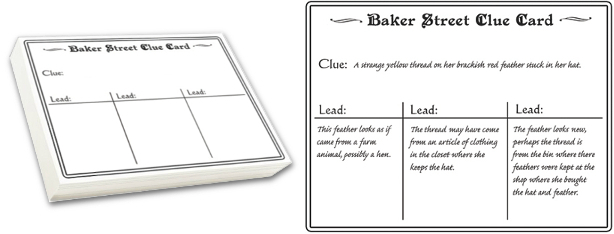
Clue cards are provided with the Observation phase of the investigation. A chart is provided which mitigates a roll difficulty for a scene corresponding to the number of clues-which may be discovered and the appropriate number of successes to maintain balance. Clue cards each provide three potential leads which will be further scrutinized in the Reason and Deduction phases. Some of these clues are false leads and will need to be scrutinized using reason and deduction.
Investigations will have a number of scenes, typically four per investigation (case). An investigation scene works as described above but the investigators may take on another scene (in the same place) to gather more clues/leads. However doing this raises the Threat Meter.

The Threat Meter in Baker Street is meant to provide tension to the story. Basically, the higher the threat meter gets-the more difficult the investigators will have in solving the case. As the threat meter rises, investigative rolls become more difficult in an addition to other possible difficulties-determined by the Mastermind. There may be points in the investigation where the investigators may have to decide to forgo the gathering of clues, in order to avoid raising the Threat Meter-this can happen if the rolls for gathering clues are really awful etc.
Baker Street comes with an investigation. The Case of the Jilted Bride is based on Mr. Doyle’s Fiction. This is very essential to the game itself-showing a future Mastermind the ins and outs of the game itself. Reading through it, it really helps to put some of the pieces of this game together in a meaningful way.

I don’t do scores for my reviews. If I did, Baker Street would get a pretty high total. I like this game. I’m also a fan of Arthur Conan Doyle-so I can’t help but wonder if that makes me a bit biased.
That said, Baker Street has a bit of everything. The dice mechanics and system is unique. The setting material is well presented, which a Mastermind can build more than a few cases around. I wouldn’t like printing out this PDF (full color and costly)-though the pages of parchment look rather excellent on my screen. There is respectable amount of illustrations used from the Doyle estate and quotes of Sherlock and other characters from these same works.

Overall, the game really does what it sets out to do and does it very well. Baker Street is an excellent game with a unique style and resolution to ins and outs of detective fiction in an RPG. The game as we say, is most assuredly afoot!
Savage Worlds: Fast, Furious, and Fun! - Available Now @ DriveThruRPG.com